
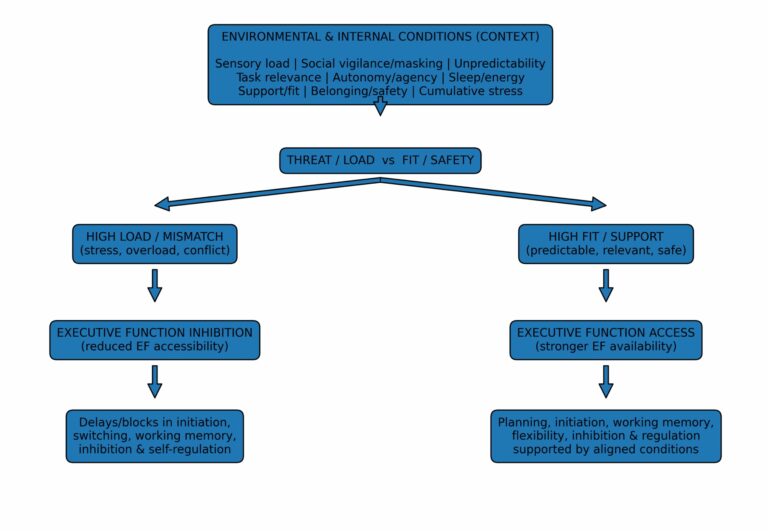
Executive Function Inhibition: An Autistic-Led Qualitative Investigation of Executive Function in Autistic Adults

By Rachel Winder First published June 2022. Revised and updated February 2026. Abstract Executive function (EF) in Autism is commonly framed as a stable cognitive impairment, frequently labelled Executive Dysfunction (ED). Yet much of the EF literature has been produced within deficit-oriented paradigms and interpreted primarily through Predominant Neurotype (PNT) norms, with limited Autistic…

Autism in society

There continues to be a lack of understanding and knowledge around the subject of Autism and ADHD within society. That same ignorance runs through the veins of our 200 year old, rigid Education system leaving Autistic-ADHD advocates like me unable to impart our valuable insight – insight which has the potential to improve the…

All humans can struggle with change

“Prioritising safety over novelty increased the likelihood of survival and, therefore, the passing on of genes” Our nervous systems did not evolve in boardrooms, classrooms, or online spaces. They evolved in environments where unfamiliar sounds, movements, or social shifts could signal danger. Even today, long after many of those threats have disappeared, the body…

Silence is not consent

There is a dangerous assumption embedded in many systems of care, authority, and decision-making: If someone does not object, they must agree. This assumption is wrong. Silence is not consent. Stillness is not permission. Inability to speak is not a yes. For many people; particularly those with histories of trauma, neurodivergence, disability, or power…

When Motherhood Arrives Before Identity

There is a quiet assumption woven through conversations about pregnancy and motherhood: that the person becoming a mother already knows who she is. That she understands her body. That she understands her limits. That she understands her needs. That she has language for distress, for capacity, for difference. For many of us, that assumption…

Self stimulatory behaviour

“The expenditure of energy performed in a bid to regain a sense of homeostasis” Our primitive survival would not waste energy on stimming if it didn’t need to do it.  (Winder, 2025). All humans mask but just like all humans lose on average 100 hairs a day as part of natural process – Autistic…

Why Assuming Competence and Incompetence is harmful

One of the most disabling experiences I encounter is not a lack of intelligence, motivation, or skill, but the way competence and incompetence are assumed by others. These assumptions are rarely neutral. They shape access to support, credibility, and opportunity, and for disabled people, they can be profoundly disabling. When I am assumed to…